Original Pilipino Music (OPM) is far more than just a musical genre; it is the collective diary of a nation. It captures the profound heartbreaks, the triumphant victories, the simple, quiet joys, and the complex, enduring struggles of the Filipino people. For the vast majority of Filipinos over the past several decades, that melodic diary was first “read” to them not through the pristine audio of a CD or the instant convenience of a streaming app, but through the crackling static and warm, resonant bass of a radio broadcast.
Before the modern era of curated Spotify playlists, viral YouTube music videos, and algorithm-driven TikTok dance trends, the radio was the undisputed king of the Philippine entertainment industry. It was the primary, and often the only, vehicle that carried the voices of legendary artists across the archipelago, connecting a diverse country of over 7,000 islands through a shared, unifying love of song. Let us take an extensive journey back in time to explore the fascinating history of how Philippine radio birthed, nurtured, and immortalized the Golden Age of OPM.
The Early Days: The Influence of the West and the Search for Identity
To appreciate the rise of OPM, we must first look at what Philippine radio sounded like in the 1950s and 1960s. During this post-war era, the airwaves were heavily dominated by American music. Big band jazz, rock and roll, and the smooth crooning of artists like Frank Sinatra, Elvis Presley, and The Beatles ruled the Philippine charts. Local artists existed, but they largely made a living by imitating Western stars, performing flawless covers of American hits in English.
While the traditional Kundiman (classic Filipino love songs) still had a place in the hearts of older generations, the youth were searching for something modern. They wanted music that sounded like the international hits they heard on the radio, but with lyrics that spoke to their own specific realities, using the language they spoke every day. The stage was set for a massive cultural revolution, and the radio was about to become the epicenter of that change.
The 1970s: The Manila Sound and the Birth of Modern OPM
The true story of modern OPM begins in the vibrant, culturally explosive 1970s with the birth of the “Manila Sound.” During this era, visionary Filipino artists and producers began moving away from purely imitating Western rock and roll. Instead, they made the bold choice to write and sing in Tagalog, or the increasingly popular “Taglish” (a blend of Tagalog and English), creating songs that directly reflected the everyday, relatable Filipino experience.
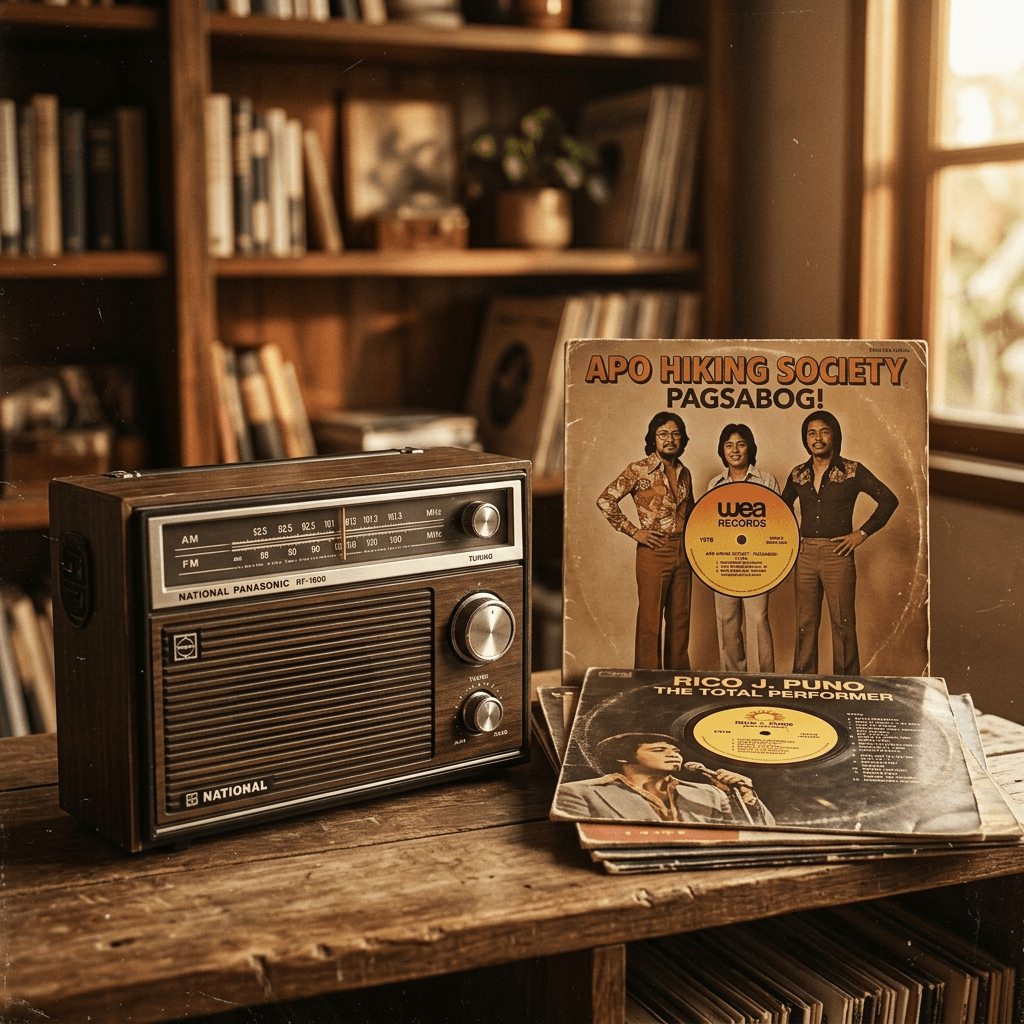
Bands like Hotdog, VST & Company, Cinderella, and the Apo Hiking Society dominated the airwaves with their catchy, disco-infused pop tracks and mellow acoustic harmonies. Songs like Manila, TL Ako Sa’yo, and Panalangin became instant, inescapable classics.
Radio stations across the capital played a massive, indispensable role in this cultural shift. By taking a chance and placing these locally produced Tagalog tracks on heavy rotation alongside massive international hits from the Bee Gees or ABBA, radio DJs validated Filipino artistry. They proved to the masses that homegrown music could stand toe-to-toe with anything coming out of America or Europe in terms of production quality, catchiness, and emotional resonance. The radio transformed local singers from mere cover artists into national icons.
The 1980s: The Golden Age of Ballads and the “Birit” Queens
As the 1980s rolled in, the energetic disco beats and funky basslines of the Manila Sound began to give way to the deeply emotional, sweeping power ballads that Filipinos are now globally famous for. This was the era where radio truly became the emotional companion and the collective confidant of the masses.
Legends like Rico J. Puno, Basil Valdez, Sharon Cuneta, Kuh Ledesma, and Gary Valenciano became absolute household names. The soaring voices of these “birit” (belting) kings and queens crackled through transistor radios in sari-sari stores, tricycles, jeepneys, and living rooms across the islands.
The radio acted as the great equalizer in Philippine society. Whether you were a wealthy corporate executive driving through Makati or a farmer tending to the fields in the distant provinces, you were listening to the same heartbroken lyrics penned by genius composers like George Canseco and Ryan Cayabyab. You were feeling the exact same emotions of longing, hugot (deep emotional pain), and unrequited love.
During this decade, radio dramas (dula-dulaan) also reached the peak of their popularity. These serialized radio shows heavily featured these OPM ballads as their theme songs, forever linking the music with dramatic, tear-jerking storytelling in the minds of the listeners. Hearing the opening piano notes of a Sharon Cuneta song on the radio instantly signaled to millions of housewives that it was time for their favorite afternoon drama.
The 1990s: The Alternative Rock Explosion
If the 80s belonged to the solo balladeers, the 1990s brought a seismic, earth-shattering shift in the OPM landscape with the explosion of the alternative band scene. The acoustic guitars and grand pianos of the previous decade were abruptly replaced by distorted electric guitars, heavy basslines, and pounding drum kits.
Bands like the Eraserheads, Rivermaya, Parokya ni Edgar, Yano, and Wolfgang spoke directly to the angst, the humor, the frustrations, and the gritty realities of the Filipino youth. They sang about failing college subjects, eating at cheap turo-turo stalls, and the complicated nature of teenage romance.
Rock-oriented FM radio stations like NU 107 and LA 105.9 became the holy grail and the cultural mecca for these rising bands. To have your rough, independently produced demo tape played on these stations was the ultimate mark of making it in the industry. These rock stations did not just play music; they cultivated an entire counter-culture. They democratized the music scene, proving that you did not need a massive recording studio or polished vocals to have a hit; you just needed a guitar, a good story, and the support of a brave radio DJ.
The Role of the Radio DJ: The Original Influencers
It is absolutely impossible to talk about the history and the success of OPM without acknowledging the vital, irreplaceable role of the Radio DJ. Long before social media influencers, YouTube vloggers, or Spotify algorithm curators existed, radio DJs were the ultimate tastemakers of the nation.
Their witty banter, their heartfelt advice during late-night love shows, and their meticulously curated playlists dictated what the country listened to and what albums they bought. They were the gatekeepers of cool, holding the power to break new underground artists and turn them into national rockstars practically overnight.
But they were more than just human jukeboxes; they were community builders. When a DJ dedicated a classic OPM love song to a specific listener, perhaps an OFW missing their spouse or a student nursing a broken heart, it created a deeply personal, intimate connection that algorithms simply cannot replicate. The DJ was a friend, a counselor, and a guide through the landscape of Filipino music.
The Late 90s and 2000s: The Acoustic and R&B Wave
As the millennium approached, the loud distortion of the 90s rock bands softened into the acoustic and R&B wave. Artists like Nina, Juris, South Border, and Freestyle brought a smoother, more soulful sound back to the radio. FM stations adapted, shifting their formats to accommodate the massive demand for “lite rock” and R&B, proving once again that radio was capable of evolving alongside the changing tastes of the Filipino listener while continuing to champion local talent.
Keeping the Legacy Alive in the Digital Age
Today, the landscape of music consumption has drastically changed. Streaming platforms have largely replaced physical albums, and social media drives musical discovery. Yet, despite these massive technological shifts, the love for classic OPM remains stronger and more fervent than ever.
“Retro,” “Classic Love,” and “Throwback” formats remain some of the most popular, highly requested, and most heavily streamed stations on Pure Pinoy Radio. These stations serve a crucial, deeply cultural purpose: they ensure that the beautiful melodies, the poetic Tagalog lyrics, and the brilliant artistry of the past are never forgotten by the younger generations.
For the millions of Overseas Filipino Workers (OFWs) and migrants tuning in from thousands of miles away—whether they are working a night shift in Dubai, commuting in London, or resting in California—hearing a classic Apo Hiking Society track, a Regine Velasquez ballad, or an Eraserheads anthem on our digital radio platform instantly and powerfully transports them back to their childhood home. It provides comfort, nostalgia, and a profound sense of national identity.
As long as there is a radio playing—whether it is coming from an old, battery-powered analog transistor or streaming through a state-of-the-art digital app—OPM will never go out of style. It is the enduring, beautiful soundtrack of the Filipino soul. We at Pure Pinoy Radio recognize the heavy responsibility and the immense privilege of carrying this history forward. We are proud to keep that music playing, preserving the legacy of the artists who shaped our culture, for generations to come. Join us, tune in to your favorite station, and let the timeless classics of OPM take you home.